July 8th, 1776
The Liberty Bell was situated in the tower of the USA's capital building (at the time) the Pennsylvania State House (now known as Independence Hall). It rang to summon citizens to hear the reading of the Declaration of Independence which had been adopted on July 4th 1776.
The bell has the following inscription on it:
"Proclaim Liberty Throughout All the Land unto All the Inhabitants Thereof"
At the close of the reading the bell in the cupola pealed forth the glad tidings of the birth of the Nation and the spectators "gave their hearty consent with three loud huzzas and cried out "May God long preserve and unite the Free and Independent States of America."
Saturday, July 8, 2006
Liberty Bell Rings - July 8th, 1776

Saturday, July 1, 2006
Independence Day
It's just a few days before the 4th of July, so I thought a little  history review might be in order .... It's fun for me to remember what it's all about too!
"The second day of July, 1776, will be the most memorable epoch in the history of America. I am apt to believe that it will be celebrated by succeeding generations as the great anniversary festival. It ought to be commemorated as the day of deliverance, by solemn acts of devotion to God Almighty. It ought to be solemnized with pomp and parade, with shows, games, sports, guns, bells, bonfires, and illuminations, from one end of this continent to the other, from this time forward forever more."
When John Adams (the 1st Vice President and 2nd President of the United States) made the above statement, he was actually off by two days. Yes, the vote on July 2nd was the decisive act, but July 4th was/is the date of the Declaration itself.
The Declaration of Independence is the document in which American colonists proclaimed their freedom from British rule.  The Second Continental Congress, with representatives of the 13 British colonies in America, adopted the declaration on July 4, 1776. The document included an expression of the colonists’ grievances and their reasons for declaring freedom from Britain. The Declaration of Independence’s eloquent rhetoric and political significance rank it as one of the great historical documents.
The first celebration took place in Philadelphia on July 8, 1776, four days after the Declaration of Independence was adopted. On that day the declaration was read aloud, city bells rang, and bands played. Within a few years the Fourth of July was observed throughout most of the new nation.
Today,  many Americans observe the Independence Day holiday by having parades, picnics, barbecues, or other outings with friends and family. Community fireworks displays take place in the evening. The Fourth of July fireworks displays in many large cities are broadcast on television.
Learn more about this holiday:
http://www.sunniebunniezz.com/holiday/4ofjuly.htm
Read the Declaration of Independence text: http://www.imustread.com/html/declaration.html
Tuesday, June 27, 2006

Ten tips to build English vocabulary
Feeling overwhelmed trying to memorize so many vocabulary words? It doesn't need to be a daunting task! Check out these top strategies and practical pointers that can help you build your word power!
Connect: It's easier to memorize words based on a common theme. Make your own connections between words and possibly organize them in a spider diagram.
Write: Practically using vocabulary can help it stick in your mind. Write sentences with new vocabulary words or compose a story using a group of words or expressions.
Draw: Expose the artist in you by drawing pictures related to the words you study. Your drawings can help trigger your memory in the future.
Act: Get your moves on by acting out words and expressions you learn. Or, imagine and act out a situation where you would need to use them.
Create: Design flashcards in English and study them in your spare time. Each week make new ones, but continue to review all of them.
Associate: Assign different colors to different words. This association will help you recall vocabulary later.
Listen: Think about other words which sound similar to the words you're learning, especially complex words. Associate the other words with this new word to help you remember the pronunciation.
Choose: Remember that topics that interest you will be easier to learn. Therefore, carefully select words that you will find useful or interesting. Even the process of making the choice is a memory aid!
Limit: Don't try to memorize the dictionary in a day! Limit yourself to 15 words per day, and you'll gain confidence instead of feeling overwhelmed.
Observe: Keep an eye out for the words you're studying when reading or listening to English.
http://encarta.englishtown.com/sp/Portal.aspx?Otag=O00269
Monday, June 26, 2006
 Don't Panic the Skunks
Marlene, a mother of six children, walked into the house one day and spotted her children huddled together in a circle. When Marlene approached her children to see what the intense interst was, she could hardly believe her eyes. In the middle of the circle of attention were several baby skunks.
The shocked mother screamed at the top of her voice, "Children! Run, run, run!"
At the sound of their mother's alarmed voice, the children each grabbed a skunk and ran. The screaming and panicking set of the danger alarm in the skunks, of course, and each one off them dispelled its horrible scent. Each and every child became mercilessly doused with the hideous smell.
The lesson here is quite simple: The mother had caused the very chaos the she feared simply by
overreacting to the situation. We can learn a lot about people and their reactions from this story.
Allowing situtions to be blown out of proportion does not help to handle difficult situations or difficult
people, for that matter. Don't allow another's difficult behavior to consume your life. It may caouse th double
stress - or as it was this case, six-times as much stress!
Saturday, June 17, 2006
Once we become adults, most of us recognize without a doubt that social skills are critical to success and happiness throughout life. We need to effectively work with others, resolve conflicts, communicate, and make and sustain relationships. Friendship is not a structured curriculum taught along with reading and math. Children usually learn the subtle nuances of social interaction through trial, error, and experience, and by watching the adults around them succeed in social situations. But, so do we! We adults must learn these things as well ... remembering to:
Effectively work with others - Assumptions are the termites of relationships. ~Henry Winkler- Resolve conflicts - Forgiveness does not change the past, but it does enlarge the future. ~Paul Boese
- Communicate - When people talk, listen completely. Most people never listen. ~Earnst Hemingway
- Make and sustain relationships - To know when to be generous and when firm—that is wisdom. ~ Elbert Hubbard
Friendship is born at that moment when one person says to another: "What! You, too? Thought I was the only one." ~C.S. Lewis
Wednesday, June 14, 2006

Of course, it goes without saying (ha ha ha), that speaking too loudly will irritate your listener!
A smooth, easy cadence when speaking will endear your listener to you and what you have to say. Make a choice to use a natural, friendly and pleasant voice.
Be aware of your voice and how it sounds. When you have a smile in your heart, it reflects in the tone of your voice. Which brings me to CELL-PHONES!
Cell phones are a technological privilege that most of us, of course, find useful in our day-to-day lives. At the same time, however, many people agree that cell-phones have also created an unwanted intrusion in our lives.
According to a recent article in the Washington Post, a transit police officer arrested a woman who was disturbing the peace with loud cell-phone talk. She has been charged with disorderly conduct and resisting arrest.
Sakinah Aaron had, in George Saoutis’s view, been talking just a bit too loudly into her mobile as she walked into a Metro station in Washington DC. He told the pregnant 23-year-old to lower her voice - and was promptly informed that he had no right to tell her how to speak. There followed a verbal exchange and some pushing and shoving before Aaron found herself stewing for three hours in a cell.
Eventually, she was released but the Transit Police say the officer was protecting the peace by removing a woman who had overstepped the boundaries of civil behavior because she was loudly cursing into her phone.
While some free speech advocates say it's the Transit Police who overstepped boundaries, others believe that when it gets to the point where people are not using proper speech etiquette, the proprietor of a closed space has the right to enforce the etiquette.
Here are a few guidelines to follow in cell-phone etiquette, which we can apply when speaking face to face with a person, as well:
Speak softly and gently so you may not disturb others
Keep your distance from other people
Keep you conversation private
Keep a civil and pleasant tone
Turn off your cell phone or put it on vibrate or in silent mode where it would be rude if a phone rang. (such as at the movie, or during church - for heaven's sake!)
Saturday, June 3, 2006
Initiative:
One of the great advantages of the swan is its abiltiy to fly as a flock in a V-formation. Its speed would be drastically reduced were it not for the flock's ability to fly in this manner. The whistling swan is capable of attaining speeds up to 100 miles per hour. 
It has been calculated that 25 birds flying in a V-formation are able to travel 70% farther than one swan flying by itself. This tremendous increase in distance is possible because the lead swan "breaks the trail" for the others which follow. Consequently, air resistance is lessened as each swan benefits from the upwash of the widening wake of the one preceding it. Less total lift power is required!
The lead swan has the most difficult task. When it becomes tired, however, it drops back and a new leader takes over, giving it an opportunity to rest. For some swans the great northerly return flight may be as long as 3,000 miles. Because of the initiative of one swan in taking the lead, the swans are able to relieve the pressure from others in the flock and greatly increase the speed at which they travel!
"A community is like a ship; everyone ought to be prepared to take the helm." -- Enrik Ibsen
"Time is neutral and does not change things. With courage and initiative, leaders change things." -- Jesse Jackson
"Nothing so conclusively proves a man's ability to lead others as what he does from day to day to lead himself." --Thomas J. Watson
Tuesday, May 30, 2006
I must take a momentary break in "10 Tips fo Social Success," since the article I saved and am using has gone missing. In the meantime, however, let me talk to you about "Forgive - and live longer." 
The physical healing we are looking for can sometimes come through forgiving others, but it's not easy! Experts say holding a grudge raises levels of damaging stress hormones, and that over time, this can harm the heart and raise the risk of depression!
But ... certainly forgiving takes time and effort, right? Well, that's ok!
Holding a grudge against someone brings on all kinds of invisible stress, and according to research done at Hope College in Michigan, when people remember past slights:
- their blood pressure increases
- their heart rate increases
- their muscle tension is higher
Other research suggests that stress hormone levels increase when we can't forgive and forget! The result is a weaker immune system and possibly imparied neurological function and poor memory - wow!
The remarkable thing is that when we really love our neighbor as ourselves; We do unto others as we do unto ourselves; We hate others when we hate ourselves; We are tolerant toward others when we tolerate ourselves; We forgive others when we forgive ourselves; We are prone to sacrifice others when we are ready to sacrifice ourselves. -- Eric Hoffer
Saturday, May 20, 2006
Tips for Social Success - #3
Keep it Short:
Tellin g long stories about people and topics others may not know or care about will bore and tire them. It's better to get right to the point.
Be sure to make eye contact, include some questions for your listener in your conversation, and watch for signs of your listener losing interest:
- If your listener isn't making eye-contact with you, this could mean you've lost them already.
- Does your listener want to ask questions? Keep them on track by saying you'll get to their question is just a second.
- Is your listener relaxed? That's great!
- If your listener changes the subject, it may be he/she is unable to keep interested in what you have to say, and it's definately time to GET TO THE POINT!.
- Has your listener tried to change the subject? Not good! It may be that your listener is not practiced at being a good listener, but that isn't your concern right now.
- Is your listener smiling, or crossing her arms and shifting her weight from one leg to the other? Look for little signs that you're losing his/her interest by watching body language.
It's just make sense, and is definately good practice to remember to KEEP IT SHORT!
Friday, May 19, 2006


Tuesday, May 16, 2006

Jaroslav Pelikan falls asleep in the Lord
Christ is Risen!
We have just learned that my husband's first cousin and St. Vladimir's seminary trustee Dr. Jaroslav Pelikan, fell asleep in the Lord this afternoon; Saturday, May 13 around 2:30 pm ... after a long battle with lung cancer.
The schedule of services in the St. Vladimir's seminary chapel is as follows:
Tuesday evening; May 16, 7:00 pm VIGIL (FUNERAL) SERVICE
Wednesday morning; May 17, 9:00 am MEMORIAL DIVINE LITURGY
Recognized by many as the most noted church historian of our time, Dr. Pelikan, along with his wife, Sylvia, made St. Vladimir's his parish home upon his reception into the Orthodox Church in 1998.
Memory Eternal!
Click below to read more about this incredibly amazing man:
http://www.yale.edu/history/faculty/pelikan.html
http://www.loc.gov/loc/kluge/pelikan.html
http://en.wikipedia.org/wiki/Jaroslav_Pelikan
Sunday, May 14, 2006

How did Mother's Day begin, anyway?
The custom of honoring mothers goes back at least as far as 17th-century England, which celebrated (and still celebrates) Mothering Sunday, celebrated the 4th Sunday of Lent.
... but, in America Mother's Day was first suggested in the year 1872, by a well-known woman, Julia Ward Howe (she wrote the words to a famous hymn - The Battle Hymn of the Republic). There was already a day in May dedicated to peace, and every year Mrs. Howe would hold organized Mother's Day meetings in Boston, Massachusets.
In 1907, a Philadelphia woman by the name of Ana Jarvis, began a campaign to establish a national Mother's Day. Ms. Jarvis persuaded her mother's church in Grafton, West Virginia to celebrate Mother's Day on the second anniversary of her own dear mother's death, the 2nd Sunday of May. By the next year Mother's Day was also celebrated throughout Philadelphia.
Ana Jarvis and her supporters began to write to everyone they could think of, with the idea of establishing a national Mother's Day. They was successful! By 1911 Mother's Day was celebrated in almost every American state. President Woodrow Wilson, in 1914, made the official announcement proclaiming Mother's Day as a national holiday that was to be held each year on the 2nd Sunday of May.
Wednesday, May 10, 2006
Tips for Social Success - Tip #2
"Don't flaunt knowledge. You may think it makes you look smart and informed, but others may find you pompous. "Talking at" people is the kiss of death in making a good impression."
To be enriching, knowledge must be combined with love. We must learn how to share truth and knowledge in love, without singing our own praises!
In the Bible (I Corinthians 8:1-2), the Apostle Paul tells us that knowledge puffs up, but love builds up:
"If anyone fancies he knows anything, he does not yet understand as he should; but if anyone loves God, that person is known by Him." The "building up" given in Scripture here is like the way it is when building a house, where "puffed up" carries a meaning of being inflated like a balloon.
Paul is certainly not condemning knowledge, and of course, neither am I. Indeed, he was probably the most knowledgeable apostle of all; a highly educated and cultured man. That knowledge was put to great use in the service of God later in his ministry, but before his conversion to Christ, he used his knowledge to persecute Christians. Later he confessed that he esteemed everything he had before he came to know Christ, including his knowledge, to be quite useless and meaningless.
Paul also said: "Faith without works is dead." Likewise, "Knowledge without love is dead." In fact, knowledge without love is a dangerous enticements. Remember this: true knowledge comes out of love. True knowledge is a fruit of love. It is humble, not boasting, not attention-seeking. False knowledge is occupied with the "self" in a bid to impress others. It only puffs up the soul in pride.
Friday, May 5, 2006
Seven seconds is the average length of time you have to make a good first impression.
Although individuals should be judged by their worth, it is often a first impression that determines whether someone will take the time to let you reveal it. What a shame to allow an unwitting social blunder, such as an incorrect introduction, an inappropriate question, or an absent handshake, be the determining factor of whether someone gives you the time you need to show your attributes and abilities. If your initial meeting is not good you won' t ever get another chance to make a good first impression.
Some years ago, I cut out a little article named "10 Tips for Social Success," with the hopes of sharing it with others, and just remembering these tips for myself. Over the next 10 days, I will share these tips, along with a little of my own commentary to go with:
1) "Share the Stage! Talking about your interests is fun, but remember that social encounters can be short and others enjoy talking about their interests too."
The word ‘etiquette’ used to mean "keep off the grass". Louis XIV’s gardener noticed that the aristocrats were walking through his gardens and put up signs, or étiquets, to ward them off. The dukes and duchesses walked right past these signs. Due to this blatant disregard, the King of Versailles decreed that no individual was to go beyond the bounds of the étiquets. The meaning of etiquette would later include the ticket to court  functions that listed the instructions on where a person would stand and what was to be done. Etiquette, like language, has evolved, but it still means literally "keep off the grass". Until the 1960’s, the importance of good manners were taught without question, but with the liberated 70’s came a decline in the popularity of teaching proper etiquette. In 2004, a new emphasis has been placed on returning to traditional values. Proper etiquette and protocol has given children and adults alike a vital tool that not only provides a competitive edge, but a sense of confidence.*
* From an article written by Dorothea Johnson, Protocol School of Washington
Wednesday, May 3, 2006
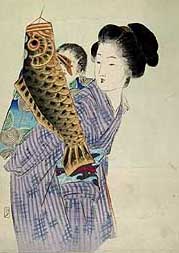
Celebrating Boys Day Koinobori - Carp Streamer By Keigetsu (1876-1963)
Golden Week in Japan is a group of national holidays, beginning with April 29th and ending with May 5th.
With well-placed weekend, this is not only the longest holiday period in Japan each year, but a very popular time for many family traditions, as well.
April 29: Midori no Hi
- Green Day, -April 29 was the birthday of Emperor Hirohito, Showa period, who died in 1989. Following his death, the holiday was changed to Midori no Hi, in honor of the environment and nature.
May 3: Kenpo Kinenbi
- Constitution Day - on May 3, 1947, the new post-war constitution became law.
May 4: Kokumin no Kyujitsu
- "Between Day" This recently created national holiday was added in order to make the Golden Week a continuous holiday period.
March 5: Kodomo no Hi
- Children's Day - This holiday was originally called Tango no Sekku or Boys Day or Festival. Families with boys would celebrate by flying koi nobori or carp streamers and gogatsu ningyo or May dolls.
Now all children celebrate this holiday with their parents and enjoy special foods such as rice dumplings wrapped in bamboo leaves and mochi wrapped in oak leaves. Oak and bamboo symbolize longevity and strength. Hinamatsuri or Girls Day is celebrated on March 3 and is not a national holiday, although there are many that feel it should be.
Travel Hint :If you are going to Japan on business, do not go during Golden Week! However, if you are looking for a lovely time of the year and a cultural experience, by all means, a visit during this week is a great idea!
Friday, April 28, 2006
Easter Babies!
Easter has always been a special time in my life. When I remember Easter's past, a flood of wonderful memories comes crashing in. This year is a special year too, however. New life is all around the Pelikans!
Easter is a time for celebrating the new life we have in Christ, and what I like to call "The Power  of the Third Day." That Power is our Lord's victory over death, as He rose from the grave; Easter is the culmination of an especially long season of penitance and prayer, which helps us even more to appreciate Christ's sacrifice for us. The Easter egg is a symbol of resurrection, representing the emergence of Christ from His tomb to everlasting life.
This Easter Season, not only everlasting life, but we celebrate the return from war of our son, John, and his first Easter with his daughter, Karis Lei. (Last year John was in Iraq, and Rondi & Karis Lei celebrated Easter in Japan with Mimi & Papa)
We celebrate the new life of our second grandaughter, Misha Rose, as well. Jesse & Elina are continuing the Pelikan tradition of raising precious, joyful, and gentle little girls - Karis Lei and Misha Rose!
Even though we Pelikans are separted by many miles, our hearts are always joined in love, prayer, and devotion - for God, and for one another.
Wednesday, April 5, 2006
Just as we long to hear certain things from our husbands, our husbands long to hear us say certain things too! Here are a few ideas:
- Thank you .
- I'm sorry.
- Other men could learn alot about _____ from you.
- You are wonderful.
- That was really great.
- You're so smart.
- You look so handsome in that shirt.
- You brighten up my day.
- Thank you for being my husband.
- I don't feel whole without you.
Friday, March 31, 2006

Today is another day in the healing of my broken foot saga. It seems a never-ending recovery process, and I just want it to be all better - NOW! I take my time up and down the stairs, but I'm hopelessly impatient. I generally find it impolite to go on at too great a length about one's own aches and pains but I feel as though I need to document this publicly as part of documenting my life (I think).
Here is where the break is:
Looking at the picture you'll see the very tip of the 5th medatarsal bone (toward the middle of the foot) just where it meets the cuboid bone; this is where the break is. It is tecnically a toe-bone, and I broke a piece of it off, as well as cracking it somewhat. I rolled my entire foot, so all the toes were black and blue, and are only now starting to feel somewhat normal.
I must say, however, that it is wonderful to have my husband home! A few weeks of crutches, a two-story house, and trying to take care of myself, was no small feat! I did it though, with the help of a few friends and the love of my wonderful dog, Sherman. He was, and is, my constant companion.
Sunday, March 19, 2006
7 Ways to show your committment to your spouse!
Go to a place that holds special memories for both of you and talk about the following commitments, or make a new special place, and promise to:
- Never publicly hurt each other.
- To protect each other's reputation and feelings .
- To be faithful emotionally and sexually .
- To keep promises .
- To be honest .
- To never threaten divorce .
- To love each other all through your lives
- Never throw trantrums!
... speaking of tantrums...
Using Time-Outs
Most of us know that when kids are somewhere between 2 to 3 years old, they are also ready for a fairly new concept to them - the Time-Out! Time-outs work like this: When your child misbehaves, for every year of her age, she gets one minute to sit quietly in a chair or in her room to calm herself down (for example, a 3-year-old gets three minutes). She gets up when you say so, or the bell goes off on the timer and time-out is over.
Of course, every child is different, and no one discipline method will work all the time. Our role during this phase is to teach our children to make choices, to teach them to grow up as dependable, highly functioning people, right? But the more practice you get working it out, and the more your child understands boundaries, the happier everyone will be. Most young children have temper tantrums at some point. There are three basic reasons: one, she is tired, sick or she is overwhelmed with feelings of helplessness and frustration, and these feelings can't be held in any longer; two, she's angry because you didn't give in to her and she wants to be independent and have her own way; and three, she's trying to get your attention because she feels left out, ignored or lonely.
With this in mind, it might not be a bad idea that when I misbehave (extended temper tantrum phase), should I not sit quietly in a chair or in my room and set a timer for 50 minutes to calm myself down? (Hmmmm ... this could be profound!)
Wednesday, March 15, 2006
Ten Things to Never Say to Your Spouse
- What's wrong with you?
- I wish you were more like__________.
- All you ever do is complain.
- I can never make you happy.
- What did you expect?
- Don't you think you got what you deserve?
- You're lazy. All you do is__________.
- You're irresponsible.
- You're just like __________. (your mother, father, sister, etc.)
- I don't know why I put up with you.
Friday, March 3, 2006
 Happy Birthday, Jess!
It's March 3rd here in Japan, but in America it's March 2nd ... a very special day for the Pelikan family. Or now32 year-old son, Jesse, was born on this day, and the Phil Pelikan family began! He has a family of his own now(pictured here with his new baby girl, Misha), and we are so proud of him, but especially today! We honor him~
Today in Japan it's girls day, Hina Matsuri, or Girls' Day Festival, which is held every year on March 3rd as a celebration of spring, when the ornamental peach trees are in bloom. Traditionally, the dolls have been given to a girl on the occasion of her first "Hina Matsuri" by relatives and close friends. They are often passed from mother to daughter as family heirlooms.
Karis received her first doll when she was here in Japan for her first Hina Matsuri, by our very dear friend Satchiko Young. Now that we have this precious new addition to our family, she will need her own doll too!
Subscribe to:
Posts (Atom)